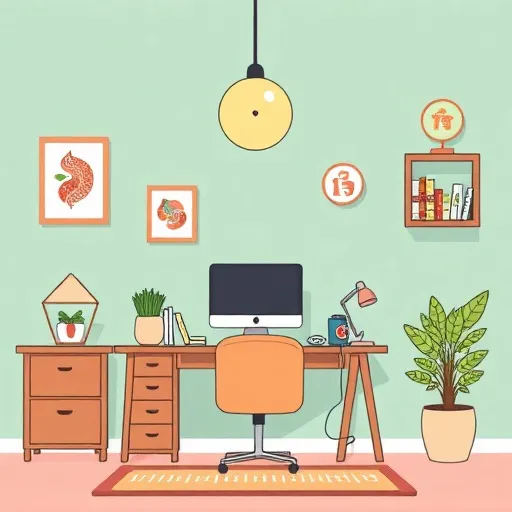
Ancient feng shui en
Why Feng Shui Still Matters for Your 2026 Home Office
Let's get one thing straight right out of the gate: feng shui isn't some woo-woo trick where you hang a lucky charm and magically hope your Wi-Fi gets faster. Nope. At its core, it's an ancient system for arranging your environment to support clarity, focus, and overall wellbeing. And honestly, in an era where your desk doubles as your conference room, your lunch table, and sometimes your therapist's couch, that stuff matters more than ever. Knowing how to arrange a home office desk with feng shui has become a genuinely practical skill for anyone working from home in 2026.
When you apply feng shui principles to a home office desk setup, you're really doing three things at once:
- Placing your workspace where you can see what's coming — both literally and psychologically
- Clearing clutter and stagnant energy so your brain isn't constantly getting distracted
- Balancing the five elements — wood, fire, earth, metal, and water — so the room feels harmonious instead of chaotic
None of this requires you to believe in anything supernatural. Think of it as environmental psychology with a few thousand years of field testing behind it. If a layout makes you feel more grounded and less scattered, it's working — and that's honestly the whole point. Learning how to arrange a home office desk with feng shui is really just learning how to set yourself up for success.
The Command Position and Room Layout: Why Your Desk Placement Changes Everything
If you only take one thing away from this whole article, make it this: the command position. In feng shui, the command position is where you sit with a solid wall behind you and a clear view of the door — ideally positioned diagonally across from the entrance, not directly in line with it. This single principle is the foundation of how to arrange a home office desk with feng shui.
From an NLP and behavioral standpoint, this is absolute gold. Sitting with your back to an open doorway keeps your nervous system in a low-grade state of alert — you can't see who or what is entering, so part of your attention is always on guard. Facing the entrance with a wall at your back signals safety to your brain. That translates directly into longer focus sessions, less decision fatigue, and a calmer mental state.
Not every home office allows a perfect command position, though. Small rooms, awkward room layout, and shared spaces all create constraints. Here's how to adapt when you're figuring out how to arrange a home office desk with feng shui in a less-than-ideal space:
- Use a mirror placed so you can see the doorway reflected behind you — a classic feng shui remedy for back-to-door seating.
- Angle the desk diagonally rather than pushing it flat against a wall, so you gain a wider view of the room.
- Add a tall plant or shelving unit behind you to create a sense of a "solid backing" if a wall isn't available.
- Avoid sitting directly in line with the door — being in the direct path of incoming energy is considered draining in feng shui.
If you absolutely must face a wall, keep a small mirror or reflective object on your desk so you retain some awareness of the room. It's a tiny tweak with an outsized effect on how settled you feel — and it's a key trick for how to arrange a home office desk with feng shui when your room fights back.
Desk Placement Scenarios: Bedrooms, Living Areas, and Dedicated Offices
The desk placement question is where most people get stuck, so let's break it down by common scenarios. If your desk sits in a dedicated office, you've got the most flexibility. Aim for the command position, keep the desk clear of the door's direct line, and leave space around it so energy can circulate. In feng shui, a desk crammed into a corner with no breathing room is thought to create stagnant energy — and honestly, anyone who's worked in a cramped corner knows that feeling.
If your desk lives in a bedroom — super common in 2026 as people downsize or repurpose rooms — things get trickier. The core conflict: bedrooms are for rest, offices are for activity. Feng shui generally advises keeping work and sleep energies separate, but if you can't, here's the playbook for how to arrange a home office desk with feng shui in a bedroom:
- Place the desk as far from the bed as possible, ideally on the opposite side of the room.
- Never position the desk at the foot of the bed or facing it directly.
- Use a room divider, screen, or curtain to visually separate the work zone from the sleep area.
- Cover or close down your workspace at the end of the day — a folding screen or a simple cloth works wonders for energy boundaries.
If your desk is in a living area, open-plan living means your home office desk is on display. Keep it intentional: define the work zone with a rug, a distinct chair, or shelving. In feng shui, clear boundaries between functional zones help the energy of each area stay coherent instead of bleeding into everything else. That's a huge part of how to arrange a home office desk with feng shui without walls to help you out.
The Five Elements Framework: Wood, Fire, Earth, Metal, and Water at Your Desk
One of the most practical tools in feng shui is the five elements framework. You don't need to memorize a textbook — just understand the vibe each element brings and use them deliberately when thinking about how to arrange a home office desk with feng shui.
- Wood — growth, creativity, and new ideas. Think plants, wooden desk surfaces, green accents. Great for anyone in a creative or strategic role.
- Fire — passion, visibility, and recognition. A small lamp, a red accent, or a candle (battery-operated is fine) can add warmth to a cold corner.
- Earth — stability and grounding. Ceramic objects, stone textures, and earthy tones like beige and terracotta help you feel anchored.
- Metal — clarity, precision, and efficiency. Metallic desk accessories, a tidy filing system, and white or gray tones support focused, analytical work.
- Water — flow, communication, and adaptability. A small fountain, a glass of water, or deep blue and black accents can support roles that involve talking, writing, or connecting with people.
The goal isn't to cram all five elements onto your desk — it's to notice which ones your workspace is missing and add a touch of them. A room that's all metal and white can feel sterile; a room that's all fire and red can feel overstimulating. Balance is the whole game, and it's central to how to arrange a home office desk with feng shui that actually feels good to sit at every day.
Decluttering and Clutter Clearing: The Feng Shui Habit That Pays Off Immediately
Here's the part where feng shui and modern productivity advice completely agree: clutter is the enemy. In feng shui, clutter is described as stagnant energy — it blocks the flow of chi (life force) through a space. In cognitive science terms, visual clutter competes for your attention and quietly drains your mental energy every time you glance at it. So when you're learning how to arrange a home office desk with feng shui, decluttering isn't optional — it's step one.
- Clear your desktop daily. At the end of each workday, put away papers, pens, and stray objects. A clear desk surface is a clear mind.
- Handle paper immediately. Paper piles are notorious energy blockers in feng shui. File it, recycle it, or act on it — don't let it nest.
- Purge cables and tech clutter. Tangled cords are the modern equivalent of a blocked energy pathway. Cable management genuinely reduces visual noise.
- Keep only what you love or use. If an object on your desk doesn't serve a purpose or bring you joy, it's probably just taking up space and energy.
One rule of thumb from experienced feng shui practitioners: if you haven't touched something on your desk in 90 days, it doesn't belong there. Be ruthless. Your future focus will thank you — and this habit alone can transform how to arrange a home office desk with feng shui from a one-time project into an ongoing practice.
Lighting, Color, and Air Quality: The Invisible Feng Shui Factors
People obsess over furniture placement and forget the things they can't see. Yet lighting, color, and air quality are among the most powerful feng shui levers you have. Natural light is the gold standard. Position your desk so you get daylight without harsh glare on your screen — ideally, light comes from the side rather than directly in front or behind you. In feng shui, good lighting supports yang energy — the active, alert, focused state you want during work hours. This is a frequently overlooked aspect of how to arrange a home office desk with feng shui.
Color is one of the fastest ways to shift the energy of a workspace. Soft greens and blues support calm focus. Warm neutrals ground the room. Avoid overwhelming amounts of bright red or stark black in a small office — they can feel either agitating or heavy. Fresh air and living plants are classic feng shui boosters too. A plant in the wealth corner is a traditional touch, but greenery anywhere in your home office improves air quality and lifts the mood. Just avoid spiky, sharp-leaved plants right next to your desk — in feng shui, sharp points are associated with negative energy and tension.
The Bagua Map: Finding Your Wealth Corner and Career Area
The bagua map is the feng shui energy map that overlays a grid onto your space. You don't need to go full traditionalist with a compass, but knowing the basics helps you place meaningful objects intentionally. Standing at your office door and looking in, the far-left corner is traditionally the wealth corner, and the area closest to the door's center relates to career. Common enhancements include a healthy plant or small fountain in the wealth corner, items related to your professional goals in the career area, and wood elements or a mood board in the creativity zone.
Treat this as a light touch, not a religion. The point is to make your workspace feel purposeful. When objects on your desk and shelves carry meaning, the room stops feeling like a random collection of stuff and starts feeling like a place that supports your goals. This intentional layer is what elevates how to arrange a home office desk with feng shui from basic furniture shuffling into something genuinely personal.
Ergonomics and Feng Shui: Where Ancient Wisdom Meets Modern Science
Here's a happy overlap: much of what feng shui recommends for a home office also happens to be excellent ergonomics. A command position that lets you see the door also tends to give you room to move. A decluttered desk surface also gives your monitor, keyboard, and mouse proper space. Good lighting reduces eye strain. Stable, grounded furniture supports your posture. So when you arrange your home office desk, check both boxes — monitor height at eye level, chair with lower back support, feet flat on the floor, cables routed neatly away from your feet, and frequently used items within easy arm's reach.
An ergonomic setup and a feng shui-aligned setup are, more often than not, the same setup. That's not a coincidence — both traditions care about how a space supports the person using it. Mastering how to arrange a home office desk with feng shui means you're automatically getting a more comfortable, healthier workstation too.
Common Feng Shui Desk Mistakes and a Step-by-Step Home Office Desk Checklist
Let's talk about what not to do, because some of these are surprisingly common in 2026's "desk setup" culture. Avoid facing a blank wall with your back to the door (a classic feng shui no-no and a genuine focus killer). Don't place the desk directly under a window — glare and drafts create discomfort, and feng shui considers a "floating" position with no solid backing unstable. Keep corners clean so stagnant energy doesn't pool. Angle furniture so sharp corners (called "poison arrows" in feng shui) don't point at your seat. Skip mirrors that reflect your desk or screen. Consolidate electronics so the room doesn't feel electrically "loud." And never sit in the direct path of the door. Avoiding these seven mistakes gets you 80% of the way to a well-arranged home office desk.
Now let's pull it all together into something actionable — a practical sequence for how to arrange a home office desk with feng shui in 2026:
- Choose your location. Pick a spot with a wall behind you and a view of the door. If impossible, use a mirror or a tall plant to simulate a solid backing.
- Position the desk. Aim for the command position — diagonally across from the entrance, not directly in line with it.
- Clear everything. Remove all items from the desk surface. Clean the space physically and mentally.
- Add only what earns its place. Monitor, keyboard, mouse, lamp, notebook, and one or two meaningful objects.
- Balance the five elements. Add a plant (wood), a lamp (fire), a ceramic bowl or stone (earth), a metal accessory (metal), and maybe a small water feature or blue accent (water).
- Check the bagua corners. Enhance wealth, career, and creativity areas with intentional items.
- Fix your lighting. Layer natural light with a warm desk lamp; avoid glare on screens.
- Manage cables. Route and hide cords to eliminate visual noise.
- Add ergonomic support. Adjust chair, monitor, and keyboard for comfort.
- Create a daily reset ritual. End each day by clearing the desk surface — it keeps energy flowing and starts tomorrow with a clean slate.
Run through this checklist once, and then revisit it seasonally. Your workspace evolves as your work does, and so should its feng shui. The real secret to how to arrange a home office desk with feng shui isn't a one-and-done project — it's a practice you refine over time.
A Workspace That Works With You: Intentionality and Energy Flow
Arranging a home office desk with feng shui isn't about superstition — it's about intentionality. It's about placing your desk where you feel safe and focused, clearing the clutter that drains your attention, balancing the five elements so the room feels alive rather than flat, and designing a work zone that supports the life you're actually building in 2026. Start with the command position. Clear the surface. Add a plant. Face the door. Notice how much calmer your workday feels.
And here's the most feng shui thing of all: once your workspace feels right, you'll stop thinking about it. You'll just sit down and do your best work. That's the goal. The energy is already there — you're just arranging it so it flows in your favor. Whether you're a total beginner or refining an existing setup, knowing how to arrange a home office desk with feng shui gives you a repeatable framework for a home office that genuinely supports your mental state, your goals, and your daily focus.